
FI EN
Do you recognize one or more of these?
These are not flaws. They are emotional locks — deeply rooted patterns often called schemas or life traps.
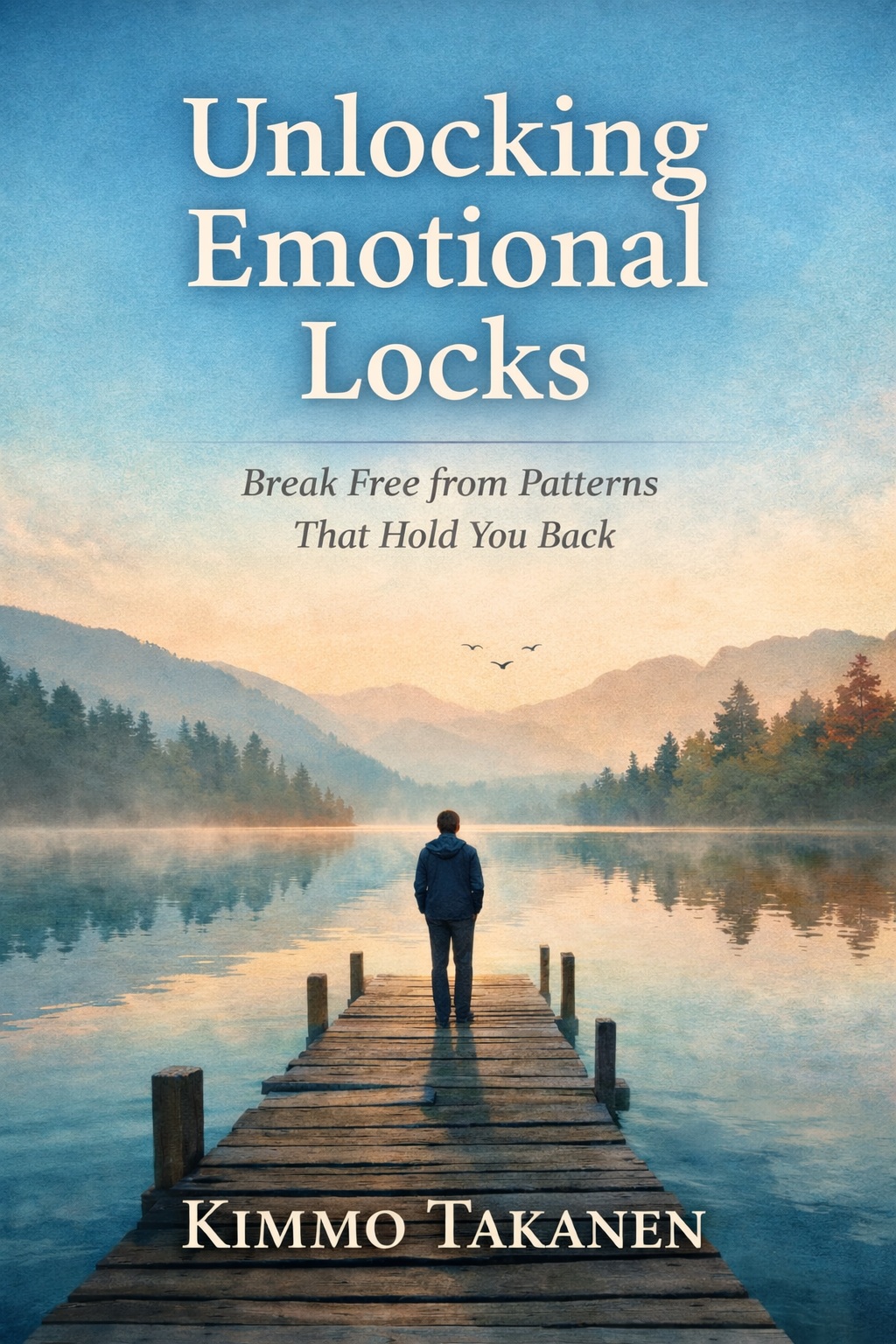
The test draws on Kimmo Takanen's long client work and schema therapy. The Finnish original of his bestselling book has sold more than 150,000 copies.
This is a broad, in-depth assessment designed to give you an overall picture of your own patterns. You receive personal results and a review of what appears most relevant in your particular profile.
This is not only a test. It is a starting point for change.
About 10–15 min • personal results
Does any of this sound familiar?
This is not a flaw. It may be connected with the Unrelenting Standards schema.
The test draws on Kimmo Takanen's long client work and schema therapy. The Finnish original of his bestselling book has sold more than 150,000 copies.
This is a broad, in-depth assessment designed to give you an overall picture of your own patterns. You receive personal results and a review of what appears most relevant in your particular profile.
This is not only a test. It is a starting point for change.
About 10–15 min • personal results
Does any of this sound familiar?
This is not weakness. It may be connected with the Self-Sacrifice schema.
The test draws on Kimmo Takanen's long client work and schema therapy. The Finnish original of his bestselling book has sold more than 150,000 copies.
This is a broad, in-depth assessment designed to give you an overall picture of your own patterns. You receive personal results and a review of what appears most relevant in your particular profile.
This is not only a test. It is a starting point for change.
About 10–15 min • personal results
Your personalized change program
It is a change program tailored to your emotional lock profile, your life situation and what you want to change.
In your personal program:
The work moves from recognizing your patterns to understanding their background, your needs and reactions, and then practising new ways of responding in everyday life.
The first step is the free Schema Therapy Test.
The program is based on Kimmo Takanen's long client work and schema therapy. AI is used to tailor the content to your own answers and profile.
The test creates the emotional lock profile on which your personal program is based. After the test, you receive your personal results and a free preview of your own program, so you can see what the work created specifically for you looks like in practice.
About 10–15 min • results, program preview and 1 Sento response free
1. Take the test
Receive your emotional lock profile and see which patterns have the strongest influence on you.
2. Explore your personal preview
See how your emotional locks may connect with one another and with your own situation. You also receive one personal Sento response free.
3. Continue with the full program if it feels right
In the full program, you progress through 14 parts, receive 36 personalized exercises and can use Sento to support your work.
The Schema Therapy Test is an in-depth self-assessment that helps you identify which emotional locks — or schemas — currently have the strongest influence on your thoughts, feelings, relationships and ways of acting.
The assessment contains 66 statements and personal questions. The statements cover 18 emotional locks. The personal questions ask about things such as your life situation, your experiences and what you would like to change.
For each statement, consider how well it describes your experience in everyday life. Your first feeling or impression is usually enough.
From a schema therapy perspective, these are deeply rooted patterns learned early in life that can continue to guide us in adulthood. They can be recognized, understood and gradually changed.
The test covers 18 different emotional locks, known in schema therapy as early maladaptive schemas. Common examples include Unrelenting Standards, Self-Sacrifice, Subjugation, Abandonment, Emotional Deprivation, Social Isolation and Approval Seeking.
Your results show which patterns are strongest for you right now.
The test, your personal results, a preview of your personalized program and one Sento response are free.
You see which emotional locks are strongest for you and what kind of overall profile emerges from your answers.
You receive a personal review based on your answers. It highlights one connection or tension in your profile that appears especially relevant to you — something that may not be obvious from individual test scores alone.
The review also serves as a free preview of Beyond Emotional Locks. You see how the program approaches your emotional locks as a personal whole rather than as isolated schemas or test scores.
Sento is the AI guide included in the change program and trained for emotional lock work. After your review, you can choose a question that fits you or write your own question about something in your situation that you would like to understand better.
Sento takes the insight from your review one step further and helps you explore how it may appear in your own situation and what you could begin to notice or try. You receive one Sento response free.
All of this is free. The full change program is a separate paid continuation only if you decide you want to continue the work further.
About 10–15 min • results, program preview and 1 Sento response free